
A new approach to infection and repair.
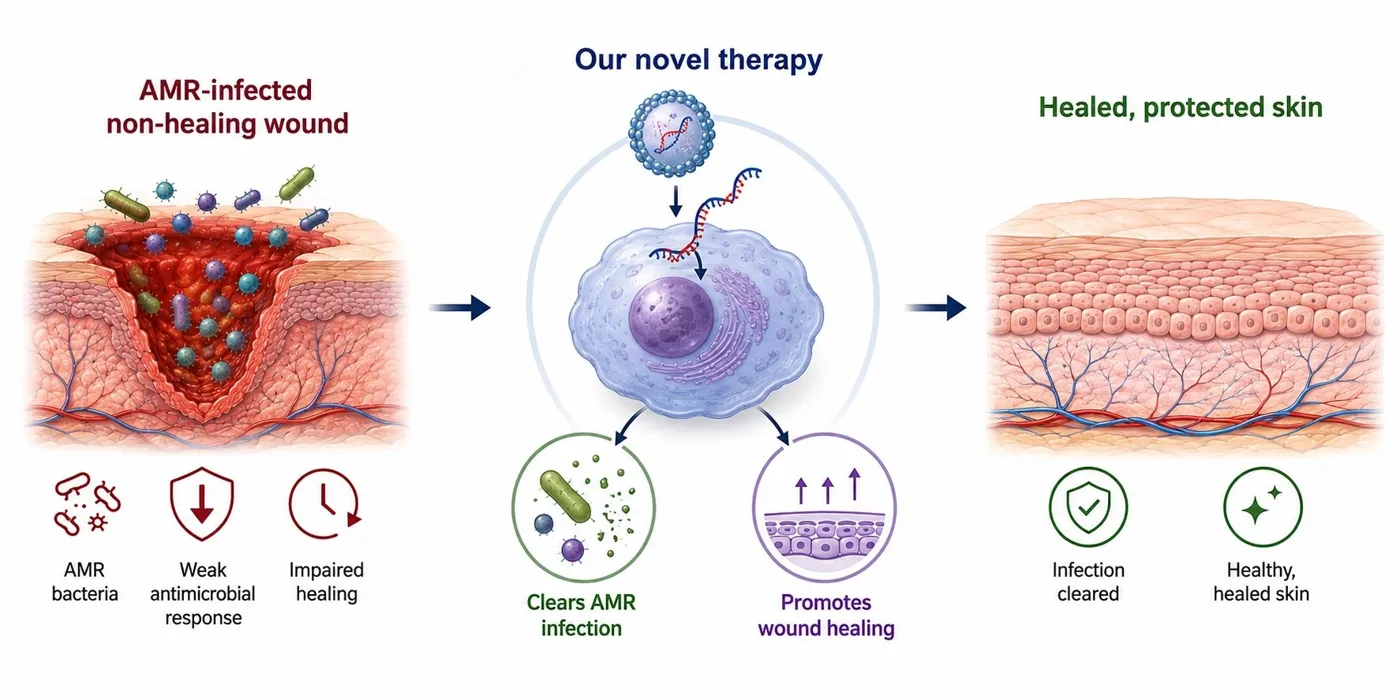
We are developing a therapy that aims to clear antimicrobial-resistant infections and promote wound healing by restoring the skin’s own response.
Antibiotic resistance, a global issue.
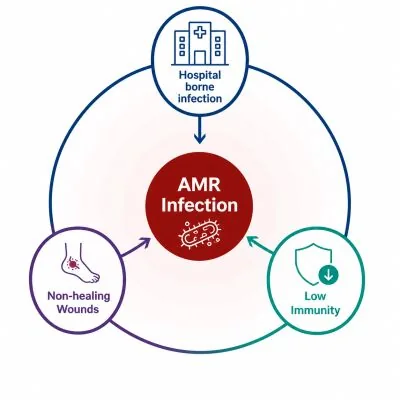
Antibiotic resistance is an exploding problem worldwide, as many antibiotics are becoming ineffective to treat bacterial infections. Around 4.95 million deaths were associated with bacterial AMR in 2019 [4]. In the absence of novel therapies, AMR could kill 10 million people per year by 2050 [5].
Who is at risk?
AMR infections disproportionately affect people with weak immunity and exposure to healthcare-associated infections. Diabetic individuals are one such group. Chronic non-healing wounds and skin infections become particularly difficult to treat when last-resort antibiotics fail, with severe consequences including amputation and systemic infection.
How to solve it?
The combination of chronic non-healing ulcers and AMR infection requires a fundamental understanding of why diabetic skin cells fail to initiate wound healing and antimicrobial responses.
Our in-house research has identified molecular mechanisms behind this susceptibility. Our therapy aims to restart the healthy wound-healing programme and antimicrobial response in skin keratinocytes, with two goals: pathogen clearance and accelerated wound healing.
The RiboKOSH platform.
Our ASO- and siRNA-based gene-silencing platform works inside skin cells to release the cell’s own antimicrobial peptide response and wound-healing programme.
The platform is designed to support a pipeline across antimicrobial resistance, chronic wounds and orphan skin disorders.
Where we are
- CompletedRNAi-inducible antimicrobial peptide cocktail discovered
- CompletedEfficacy validated in diabetic animal models and human skin explants
- CompletedPatents filed
- In progressPreparing for IND application and Phase I planning
Platform
ASO and siRNA design, lipid nanoparticle-based delivery and topical formulation.
Pipeline
AMR infection, diabetic wound healing and orphan skin disorders.
Network
C-CAMP, inStem, NCBS, Shiv Nadar Institution of Eminence and industry partners.
Team
Founder-level command of the underlying discovery science.
References
- Bhatt T et al. (2022). Initiation of wound healing is regulated by the convergence of mechanical and epigenetic cues. PLoS Biology 20, e3001777. Read reference ↗
- Bhatt T et al. (2019). Sustained secretion of the antimicrobial peptide S100A7 is dependent on the downregulation of caspase-8. Cell Reports 29, 2546–2555.e4. Read reference ↗
- Lee P et al. (2009). Dynamic expression of epidermal caspase 8 simulates a wound healing response. Nature 458, 519–523. Read reference ↗
- Antimicrobial Resistance Collaborators (2022). Global burden of bacterial antimicrobial resistance in 2019: a systematic analysis. The Lancet 399, 629–655. Read reference ↗
- O’Neill J. (2016). Tackling drug-resistant infections globally: final report and recommendations. Review on Antimicrobial Resistance. Read reference ↗
Good science starts with a question.
For research services, partnerships and collaboration enquiries, get in touch.
mail (at) koshkey.comKoshKey Sciences Pvt Ltd.C-CAMP, GKVK post
Bengaluru – 560065, Karnataka, India
Monday–Saturday · 9:00 am–6:00 pm
Sunday · Closed